How to Pretty Print SQL: Format Messy Queries in Seconds
What Does "Pretty Print SQL" Mean?
To pretty print SQL is to reformat a query so its structure is visible at a glance: keywords aligned, clauses on their own lines, nested conditions indented, and lists of columns laid out cleanly. The query runs identically either way — databases ignore whitespace — but a formatted query is dramatically easier for a human to read, review, and debug.
In practice, SQL arrives ugly all the time. It gets generated by an ORM, copied out of a log, pasted from a chat message, or written quickly and never cleaned up. A 300-character single-line SELECT with three joins and a nested subquery is a wall of text. Formatting turns it into something you can actually reason about.
Before and After
An unformatted query often looks like this: "select u.id, u.name, o.total from users u join orders o on o.user_id = u.id where o.status = 'paid' and o.total > 100 order by o.total desc". It is correct, but you have to parse it word by word.
Pretty printed, each clause sits on its own line — SELECT with its columns, FROM, JOIN with its ON condition, WHERE with its filters, ORDER BY at the bottom. The shape of the query becomes obvious, and a missing join condition or a misplaced filter jumps out instead of hiding in the middle of a line.
Why Formatting Is Worth the Two Seconds
- Faster debugging — most SQL bugs are structural: a join on the wrong column, a filter in the wrong clause, a stray AND. Clean indentation makes these visible.
- Better code review — a reviewer can follow a formatted query and catch problems. A one-line query gets rubber-stamped because nobody can read it.
- Consistent style — a formatter applies the same capitalization and indentation rules every time, so queries across a team look uniform.
- Safer edits — when each clause is isolated on its own line, changing one condition is far less likely to accidentally break another.
Formatting Across SQL Dialects
MySQL, PostgreSQL, SQL Server, and Oracle share the same core syntax but differ in details — quoting styles, specific functions, and some keywords. A good formatter understands these dialects so it indents and aligns correctly rather than mangling dialect-specific syntax. If you work across more than one database, pick a formatter that lets you choose the dialect.
Do It Privately, In Your Browser
Queries often contain table names, column names, and structure you would rather not paste into a random server. A formatter that runs entirely client-side keeps the query on your machine — nothing is uploaded, which matters when the SQL touches anything sensitive.
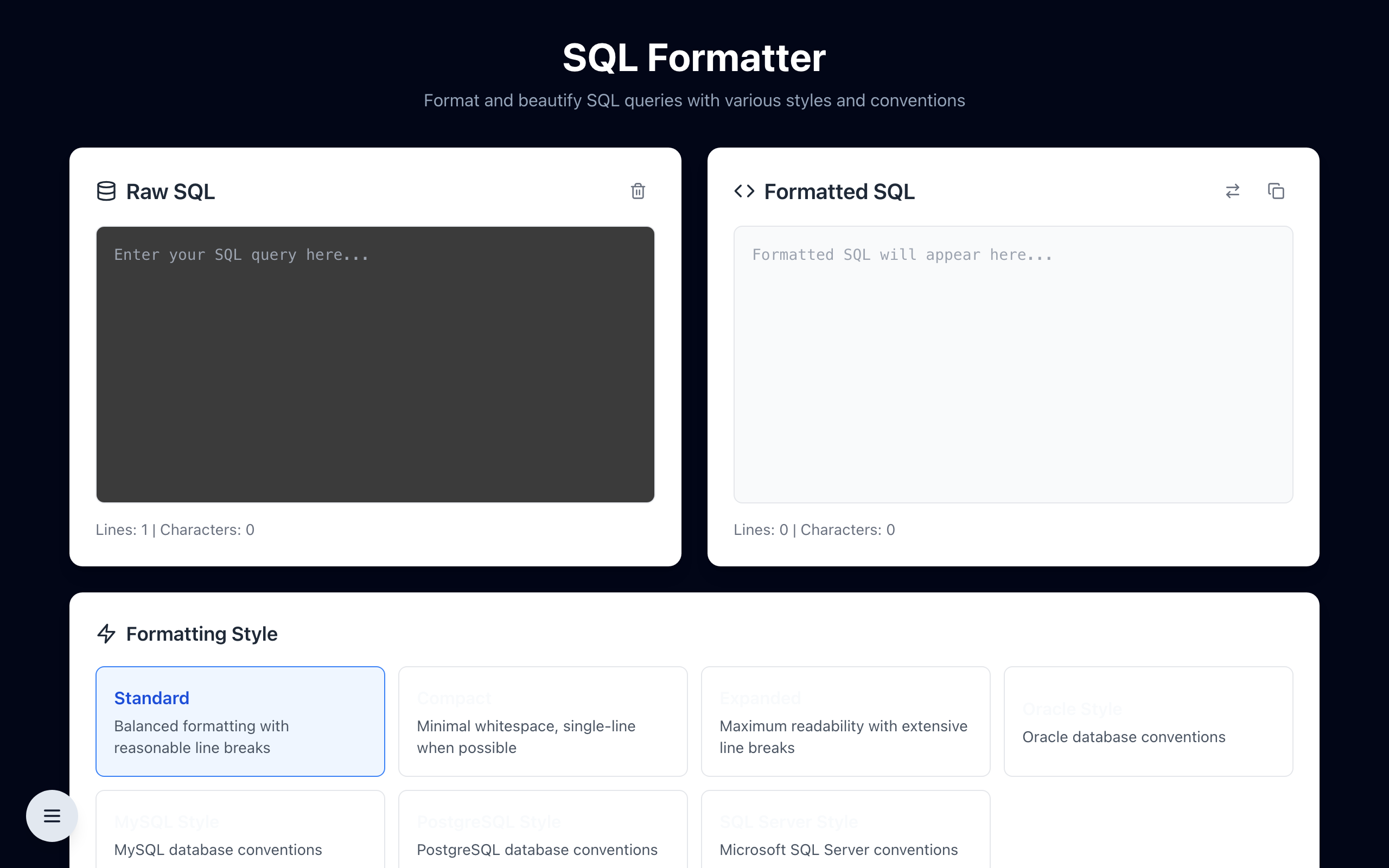
Open the free SQL formatter — paste any query to pretty print, indent, and align it instantly. Supports MySQL, PostgreSQL, SQL Server, and Oracle. No signup, nothing leaves your browser.